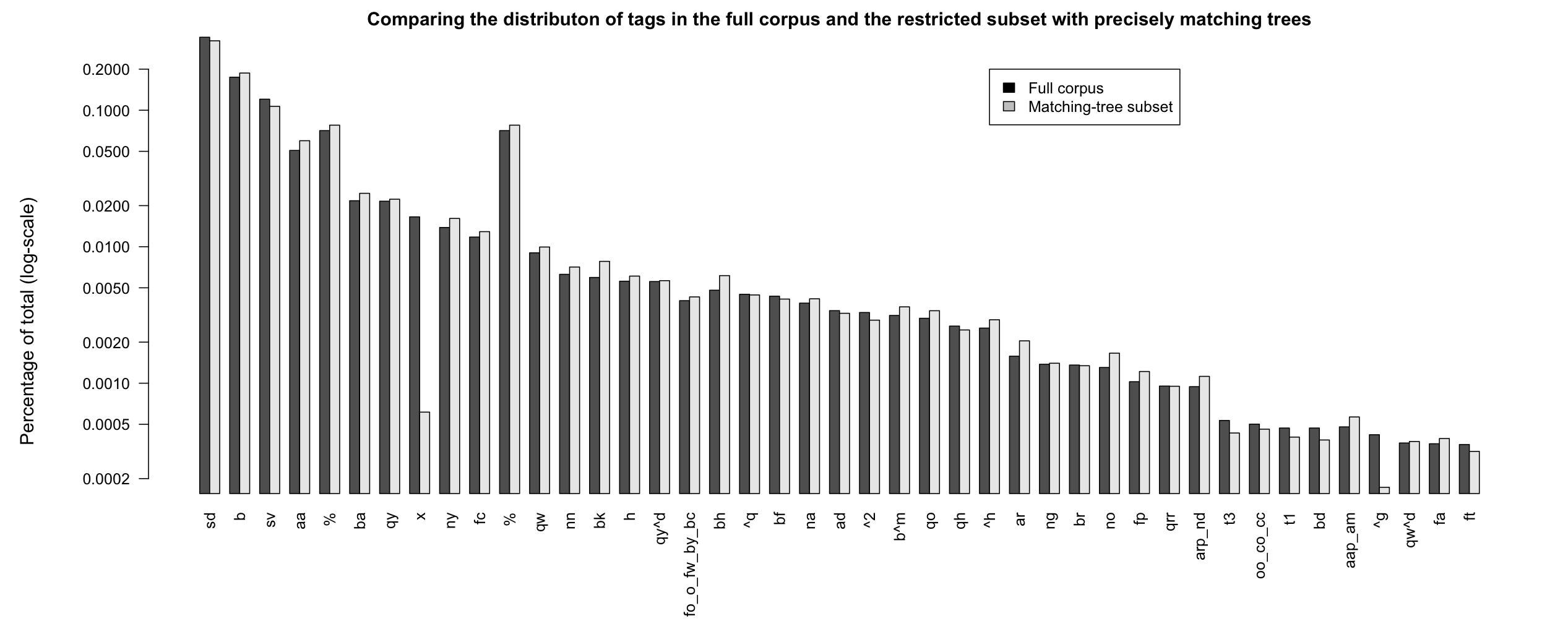
Figure PERCOMPARE
Comparing percentages of tags for the full corpus and the
restricted subset that have single, precisely matching trees.
The Switchboard Dialog Act Corpus (SwDA) extends the Switchboard-1 Telephone Speech Corpus, Release 2, with turn/utterance-level dialog-act tags. The tags summarize syntactic, semantic, and pragmatic information about the associated turn. The SwDA project was undertaken at UC Boulder in the late 1990s.
Recommended reading:
Note: Here is updated SwDA code that is Python 2/3 compatible. It is recommended over the code below.
Code and data:
The SDA trascripts are a free download:
The files are human-readable text files with lines like this:
b          B.22 utt1: Uh-huh. /

sd          A.23 utt1: I work off and on just temporarily and usually find friends to babysit,  /
sd          A.23 utt2: {C but } I don't envy anybody who's in that <laughter> situation to find day care. /

b          B.24 utt1: Yeah. /
It's worth unpacking the archive file and opening up a few of the transcripts to get a feel for what they are like.
The SwDA is not inherently linked to the Penn Treebank 3 parses of Switchboard, and it is far from straightforward to align the two resources Calhoun et al. 2010, §2.4. In addition, the SwDA is not distributed with the Switchboard's tables of metadata about the conversations and their participants. I'd like us to have easy access to all this information, so I created a version of the corpus that pools all of this information to the best of my ability:
When you unpack swda.zip, you get a directory with the same basic structure as that of swb1_dialogact_annot.tar.gz. The file swda-metadata.csv contains the transcript and caller metadata for this subset of the Switchboard.
The format for all the transcript files is the same. I describe the column values below, in the context of the Python code I wrote for us to work with this corpus.
The Python classes:
The code's Transcript objects model the individual files in the corpus. A Transcript object is built from a transcript filename and the corpus metadata file:
Transcript objects have the following attributes:
| Attribute name | Object type | Value |
|---|---|---|
| ptb_basename | str | The filename: directory/basename |
| conversation_no | int | The numerical conversation Id. |
| talk_day | datetime | with methods like month, year, ... |
| topic_description | str | short description |
| length | int | in seconds |
| prompt | str | long decription/query/instruction |
| from_caller_no | int | The numerical Id of the from (A) caller |
| from_caller_sex | str | MALE, FEMALE |
| from_caller_education | int | 0, 1, 2, 3, 9 |
| from_caller_birth_year | datetime | YYYY |
| from_caller_dialect_area | str | MIXED, NEW ENGLAND, NORTH MIDLAND, NORTHERN, NYC, SOUTH MIDLAND, SOUTHERN, UNK, WESTERN |
| to_caller_no | int | The numerical Id of the to (B) caller |
| to_caller_sex | str | MALE, FEMALE |
| to_caller_education | int | 0, 1, 2, 3, 9 |
| to_caller_birth_year | datetime | YYYY |
| to_caller_dialect_area | str | MIXED, NEW ENGLAND, NORTH MIDLAND, NORTHERN, NYC, SOUTH MIDLAND, SOUTHERN, UNK, WESTERN |
| utterances | list | A list of Utterance objects. |
The attributes permit easy access to the properties of transcripts. Continuing the above:
The utterances attribute of Transcript objects is the list of Utterance objects for that corpus, in the order in which they appear in the original transcripts.
Utterance objects have the following attributes:
| Attribute | Object type | Value |
|---|---|---|
| caller | str | A, B, @A, @B, @@A, @@B |
| caller_no | int | The caller Id. |
| caller_sex | str | MALE or FEMALE |
| caller_education | str | 0, 1, 2, 3, 9 |
| caller_birth_year | int | 4-digit year |
| caller_dialect_area | str | MIXED, NEW ENGLAND, NORTH MIDLAND, NORTHERN, NYC, SOUTH MIDLAND, SOUTHERN, UNK, WESTERN |
| transcript_index | int | line number relative to the whole transcript |
| utterance_index | int | Utterance number (can span multiple TranscriptIndex numbers) |
| subutterance_Index | int | Utterances can be broken across line. This gives the internal position. |
| tag | list | strings; see below |
| text | str | the text of the utterance |
| pos | str | the part-of-speech tagged portion of the utterance |
| trees | nltk.tree.Tree | the parse of Text; see below for discussion |
Assuming you still have your Python interpreter open and the trans instance set as before, you can continue with code like the following:
Perhaps the most noteworthy attribute is utt.trees. This is always a set of nltk.tree.Tree objects (sometimes an empty set, because only a subset of the Switchboard was parsed). For our utt instance, there is just one tree, and it properly contains the actual utterance content. In this case, the rest of the tree occurs two lines later, because speaker A interrupts:
Cautionary note: Because the trees often properly contain the utterance, they cannot be used to gather word- or phrase-level statistics unless care is taken to restrict attention to the subtrees, or fragments thereof, that represent the utterance itself. For additional discussion, see the Penn Discourse Treebank 3 Trees section below.
The main interface provided by swda.py is the CorpusReader, which allows you to iterate through the entire corpus, gathering information as you go. CorpusReader objects are built from just the root of the directory containing your csv files. (It assumes that swda-metadata.csv is in the first directory below that root.)
The two central methods for CorpusReader objects are iter_transcripts() and iter_utterances().
Here's a function that uses iter_transcripts() to gather information relating education levels and dialect areas:
The method iter_utterances() is basically an abbreviation of the following nested loop:
The following code uses iter_utterances() to drill right down to the utterances to count the raw tags:
The output is a list that is very much like the one under "Finally, for reference, here are the original 226 tags" at the Coders' Manual page. (I don't know why the counts differ slightly from the ones given there. I tried many variations — adding/removing * or @ from the tags; adding/removing a hard-to-detect nameless file in the distribution repeating sw09utt/sw_0904_2767.utt, etc., but I was never able to reproduce the counts exactly.)
It is possible to work with our SwDA CSV-based distribution using a program like Excel or R. The following code shows how to read in the CSV files and work with them a bit in R:
We can also read in the metadata and relate an utterance to it via the conversation_no value:
In principle, this could be every bit as useful as the Python classes. Indeed, there are advantages to working with data in tabular/database format, as opposed to constantly looping through all the files. However, if you take this route, you'll have to write your own methods for dealing with the special values for trees, tags, dates, and so forth. I think Python is ultimately a better tool for grappling with the diverse information in the SwDA.
I now briefly review the special annotations of this subset of the Switchboard: the act tags, the POS annotations, and the parsetrees.
There are over 200 tags in the corpus. The Coders' Manual defines a system for collapsing them down to 44 tags. (They say 42; I am not sure what they do with 'x', and their table has 43 rows, so it might be that 42 is just a minor miscount.)
The Utterance object method damsl_act_tag() converts the original tags to this 44 member subset:
The tags are the main addition to the corpus. Here is the table of training-set stats from the Coders' Manual extended with a column giving the total counts for the entire corpus, using damsl_act_tag().
, here are a few fascinating "hidden gems" from digital and cultural history: 1. The Internet Archive's "Wayback Machine"
If you want to see the "best" of the internet's past, you can visit the Internet Archive
. You can look up what major websites like Google or Apple looked like on the day they launched. Why it's interesting: You can play thousands of classic arcade games for free directly in your browser. 2. The "Lost" Media of NASA NASA maintains a massive image and video library
containing high-definition footage of everything from the Apollo moon landings to recent Mars rover missions. The "Best" Part: Check out the
images of Jupiter; they look like abstract oil paintings but are actually giant swirling storms. 3. Historical Soundscapes British Library Sound Archive
features over 6 million recordings, including rare bird calls, accents from the 1800s, and the voices of famous historical figures like Florence Nightingale. 4. Interactive Art & History Kanal – Centre Pompidou
often hosts unique digital and physical exhibitions that bridge the gap between architectural history and modern art. Kanal – Centre Pompidou 5. AI & Data Protection Trends For something more modern and technical, platforms like
provide insights into how critical global data is being protected from modern cyber threats using AI. specific type of video
(like a documentary, a music clip, or a tutorial) or more information on a specific file Kanal – Centre Pompidou – Architecture – Brussels
Here’s a generic template you could adapt:
Title: Archive FHD JUQ 986 MP4 – Best Moments
Body:
The archive labeled fhdjuq986mp4 offers a high-definition compilation of standout scenes, widely considered among the best in its collection. With crisp Full HD resolution and carefully curated segments, this file captures key highlights that showcase top-tier production quality and memorable performances. Ideal for viewers seeking a concise yet impactful viewing experience, this archive stands out for its clarity, pacing, and selection of peak moments.
If you provide more context (e.g., is this for a personal log, a video description, a review, or something else?), I can tailor the draft more specifically.
The phrase "archivefhdjuq986mp4 best" appears to be a specific search query, likely related to a high-quality (FHD) video file archived online. While there isn't a pre-existing literary "essay" on this specific filename, we can explore the concept through the lens of digital preservation and the search for "best" quality in the age of internet archiving. The Digital Ghost: Searching for "archivefhdjuq986mp4"
In the vast landscape of the internet, filenames like archivefhdjuq986mp4 act as digital fingerprints. They represent a specific moment in time—a piece of media captured, compressed, and uploaded to the "great library" of the web. The inclusion of "fhd" (Full High Definition) and "best" signals a user's pursuit of visual fidelity in a medium often defined by degradation and data loss. 1. The Quest for High Fidelity
The "best" version of a file is the holy grail of digital archiving. In an era where media is constantly re-uploaded, compressed by social media algorithms, and stripped of metadata, finding an "FHD" (1080p) source is a victory for the archivist. It represents a refusal to accept the "pixelated history" that often comes with old internet videos. 2. The Language of the Archive
Filenames that look like random strings of characters—juq986mp4—often stem from automated systems or specific database identifiers used by platforms like the Internet Archive. These strings are not meant to be poetic; they are functional. Yet, to the person searching for them, they become a unique key that unlocks a specific memory, a lost broadcast, or a rare piece of cinema. 3. The Permanence of the MP4
The .mp4 container has become the universal language of video. By searching for the "best" MP4, a user is looking for the intersection of quality and compatibility. It is an attempt to ensure that the "archive" remains accessible across all devices, bridging the gap between the technology of the past and the hardware of the future. Conclusion
"Archivefhdjuq986mp4 best" is more than a string of text; it is a symptom of our collective desire to preserve culture in its highest possible form. It reminds us that in the digital age, history isn't just written in books—it's encoded in high-definition video files, waiting to be rediscovered by those who know the right key to search for.
The following article explores the world of professional and hobbyist cosplay that these types of archives typically showcase.
The Evolution of Identity: Why Cosplay is the "Best" Form of Artistic Expression
Cosplay—the portmanteau of "costume" and "play"—is more than just a hobby for millions around the world; it is a sophisticated form of performance art that allows individuals to embody their favorite characters from anime, video games, and film. More Than Just a Costume
While a costume is the most visible element, the "play" aspect is what defines the community. This involves posing, quoting dialogue, and accurately replicating a character's persona to create an immersive experience for fans and photographers alike.
Accuracy vs. Creativity: Some artists, such as Animegao kigurumi cosplayers, use full bodysuits and masks to achieve near-perfect character accuracy. Others focus on "original cosplay," where they interpret existing characters through their own stylistic lens.
The Making of an Icon: High-level cosplay often requires a mix of skills including tailoring, 3D printing, makeup artistry, and electronics. This multidisciplinary approach is a key reason why experts consider it a legitimate art form. A Community Built on Respect
As the popularity of cosplay grows, so does the importance of community ethics. The "Golden Rule of Cosplay" emphasizes mutual respect and personal space, ensuring that the environment remains inclusive for both professional models and hobbyists. Why Archives Matter
Digital archives like "archivefhdjuq986mp4 best" serve as essential repositories for the community. They preserve:
Cosplayer Interviews: Deep dives into the techniques and inspirations of top artists.
Historical Records: Tracking how costume designs and fabrication technology have evolved over decades.
Crowdfunding & Deals: Helping artists find the resources and materials needed to bring complex characters to life.
Whether you are a veteran of the "con" circuit or a newcomer looking to build your first prop, the world of cosplay offers a unique space where imagination and reality collide. Archivefhdjuq986mp4 Best [RECOMMENDED]
The Ultimate Guide to archivefhdjuq986mp4: Why It’s the Best Choice for High-Definition Archiving
In the rapidly evolving landscape of digital media, the quest for the "best" video format is never-ending. However, for those in the know, archivefhdjuq986mp4 has emerged as a gold standard for balancing visual fidelity with long-term storage efficiency.
Whether you are a professional videographer preserving a portfolio or a casual user looking to safeguard family memories, understanding why this specific archival configuration stands out is essential. What Makes archivefhdjuq986mp4 Unique?
At its core, archivefhdjuq986mp4 isn't just a random string of characters; it represents a specific approach to high-definition (FHD) video wrapping within the MP4 container. The MP4 (MPEG-4 Part 14) format is globally recognized for its universal compatibility, but the "archive" designation implies a higher bitrate and a more robust encoding profile designed to prevent "generational loss"—the degradation that happens when files are copied or edited over time. Why It Is Considered the "Best"
When users search for the "best" archival format, they are typically looking for a "set it and forget it" solution. Here is why archivefhdjuq986mp4 fits that description:
Lossless-Lite Performance: While true lossless files are massive and impractical for most, this format uses advanced H.264 or H.265 (HEVC) compression logic to retain 99% of visible detail while keeping file sizes manageable.
Universal Playback: Unlike specialized professional formats (like ProRes or DNxHR), an MP4-based archive file will play on almost any device, from a 10-year-old smart TV to the latest smartphone.
Metadata Retention: The container allows for extensive metadata tagging, ensuring that dates, locations, and descriptions remain attached to the video file through decades of storage. Optimized Settings for Archiving
To achieve the "best" results with archivefhdjuq986mp4, certain technical benchmarks should be met:
Resolution: Full HD (1920x1080) remains the sweet spot for archiving, offering crisp detail without the storage-heavy demands of 4K or 8K.
Bitrate: For archival purposes, a constant bitrate (CBR) or a high-quality variable bitrate (VBR) of 15–25 Mbps is recommended to ensure motion remains fluid and artifact-free.
Audio: High-fidelity audio (AAC or ALAC at 320kbps) ensures the soundscape is preserved as clearly as the visuals. Future-Proofing Your Digital Library
The primary goal of archiving is longevity. Because the industry continues to support the MP4 standard, choosing archivefhdjuq986mp4 ensures that your files will be readable well into the 2030s and beyond. It eliminates the need for frequent "transcoding," saving you time and technical headaches. Conclusion
When it comes to digital preservation, "best" is defined by a balance of quality, compatibility, and size. archivefhdjuq986mp4 strikes this balance perfectly. By utilizing this format, you aren't just saving a video; you are ensuring that your digital legacy remains accessible and vibrant for the next generation.
archivefhdjuq986mp4 appears to be a specific, auto-generated, or obfuscated filename rather than a broad topical subject. In digital environments, such alphanumeric strings often represent unique identifiers for video files stored on servers, cloud platforms, or file-sharing archives.
Because this exact string does not correlate with a known historical event, brand, or academic concept, a "best" write-up typically focuses on the technical context of such files: Understanding Complex Filenames Unique Identifiers : The string
likely serves as a "hash" or unique ID to prevent filename collisions in large databases like YouTube or Dropbox. Format Specification
extension confirms the file is a digital multimedia container, commonly used for high-definition video and audio streaming due to its high compression and compatibility. Archive Context
: The prefix "archive" suggests the file is part of a preservation effort, such as those found on the Internet Archive
or private backup servers, intended for long-term storage rather than immediate social sharing. Best Practices for Handling Unknown Archives
If you have encountered this specific file and are looking for its contents, consider these safety and technical steps: Verify the Source archivefhdjuq986mp4 best
: Only download or open files from trusted repositories to avoid malware. Metadata Inspection : Use tools like
to view the file's internal tags, which might reveal the original title, creator, or recording date. Search the ID
: If this is a snippet from a URL, searching for just the unique ID (
) on the platform where you found it (e.g., Google Drive or a specific forum) may lead you to the original folder or post. analyze a different specific topic
or generate a creative story centered around a "mystery file"?
The Ultimate Guide to Archivefhdjuq986mp4: Uncovering the Best Features and Benefits
In the vast and ever-evolving digital landscape, file archiving has become an essential practice for individuals and organizations alike. With the proliferation of data, it's crucial to have reliable and efficient methods for storing, managing, and retrieving files. One such method that's gained significant attention is the use of archive files, specifically those with the extension "archivefhdjuq986mp4." In this article, we'll delve into the world of archivefhdjuq986mp4, exploring its best features, benefits, and uses.
What is Archivefhdjuq986mp4?
Archivefhdjuq986mp4 is a type of archive file that uses a combination of compression and encoding to store data in a compact and secure format. The extension "archivefhdjuq986mp4" might seem unfamiliar, but it's actually a variant of a more common archive file type. The "mp4" suffix might raise some eyebrows, as it's typically associated with video files. However, in this context, it simply indicates that the archive file uses a specific codec or compression algorithm.
Best Features of Archivefhdjuq986mp4
So, what makes archivefhdjuq986mp4 stand out from other archive file formats? Here are some of its best features:
Benefits of Using Archivefhdjuq986mp4
The advantages of using archivefhdjuq986mp4 are numerous. Here are some of the most significant benefits:
Common Use Cases for Archivefhdjuq986mp4
So, when should you use archivefhdjuq986mp4? Here are some common scenarios:
Best Practices for Working with Archivefhdjuq986mp4
To get the most out of archivefhdjuq986mp4, follow these best practices:
Conclusion
In conclusion, archivefhdjuq986mp4 is a powerful and versatile archive file format that offers a range of benefits and features. Its high compression ratio, robust encryption, and fast decompression make it an ideal choice for individuals and organizations looking to efficiently store, manage, and retrieve data. By following best practices and using compatible software, you can unlock the full potential of archivefhdjuq986mp4 and ensure the long-term preservation of your valuable data.
The Ultimate Guide to Archivefhdjuq986mp4 Best: Unlocking the Secrets of High-Quality Video Storage
In the digital age, video content has become an integral part of our lives. From social media platforms to professional video productions, the demand for high-quality video storage solutions has never been higher. One term that has been gaining traction in recent times is "archivefhdjuq986mp4 best." In this article, we will delve into the world of video storage, exploring the concept of archivefhdjuq986mp4 best and what it means for video enthusiasts and professionals alike.
What is Archivefhdjuq986mp4 Best?
Archivefhdjuq986mp4 best refers to a specific type of video file format that is optimized for high-quality video storage. The term "archive" implies a secure and organized way of storing files, while "fhd" stands for Full High Definition, indicating a high level of video resolution. The alphanumeric code "juq986mp4" appears to be a unique identifier for this particular format.
The "best" part of the term suggests that archivefhdjuq986mp4 is a superior video storage solution compared to other formats. But what makes it stand out from the rest? To answer this, we need to explore the features and benefits of archivefhdjuq986mp4 best.
Key Features of Archivefhdjuq986mp4 Best
So, what sets archivefhdjuq986mp4 best apart from other video file formats? Here are some of its key features:
Benefits of Using Archivefhdjuq986mp4 Best
The benefits of using archivefhdjuq986mp4 best are numerous. Here are some of the advantages of choosing this format for your video storage needs:
How to Use Archivefhdjuq986mp4 Best
Using archivefhdjuq986mp4 best is relatively straightforward. Here's a step-by-step guide to get you started:
Conclusion
In conclusion, archivefhdjuq986mp4 best is a cutting-edge video storage solution that offers high-quality video resolution, efficient compression, and robust security features. Whether you're a video enthusiast or a professional, this format is ideal for storing and sharing your video content. With its wide compatibility and easy-to-use interface, archivefhdjuq986mp4 best is set to revolutionize the way we store and enjoy video content.
Frequently Asked Questions
By following this guide, you can unlock the secrets of archivefhdjuq986mp4 best and enjoy high-quality video storage and playback. Whether you're a seasoned video professional or a casual video enthusiast, archivefhdjuq986mp4 best is an excellent choice for all your video storage needs.
for users who may be looking for the best way to handle, play, or convert files with this specific naming convention. Finding the Best of ArchiveFHDJUQ986MP4: A Complete Guide If you’ve stumbled upon a file named archivefhdjuq986mp4
, you’re likely dealing with a high-definition video archive. Whether you found this in a backup folder, a shared drive, or an old hard drive, getting the "best" performance out of these files requires the right tools.
In this post, we’ll break down the best ways to open, optimize, and manage these specific MP4 archives. 1. The Best Media Players for Archive Files
Standard system players can sometimes struggle with large, high-bitrate archives. For the smoothest playback of fhdjuq986mp4 files, these are the top contenders: VLC Media Player
: The gold standard. It can handle almost any codec hidden within an MP4 container, even if the file header is slightly corrupted. IINA (for Mac users)
: A sleek, modern interface that handles high-definition "FHD" content beautifully using hardware acceleration. MPC-HC (Media Player Classic)
: Extremely lightweight for those running older hardware who still want to view high-quality archives without lag. 2. Best Quality Settings (FHD Optimization) The "FHD" in your filename typically stands for Full High Definition (1080p) . To ensure you are seeing the best version of the content: Check the Bitrate : Use a tool like
to see if the archive is compressed. A higher bitrate means better visual fidelity. Monitor Refresh Rates
: Ensure your monitor is set to at least 60Hz to avoid "ghosting" during playback of high-motion archive footage. 3. Best Ways to Convert or Extract
Sometimes, you don't need the whole archive—just a specific clip.
: If the file is too large for your mobile device, Handbrake is the best tool to compress archivefhdjuq986mp4
into a more manageable size without losing noticeable quality.
: For the tech-savvy, using a command-line interface allows you to "stream copy" the video, which extracts the content instantly without needing to re-encode. 4. Troubleshooting Common Issues
Is your file not opening? Here is how to fix the most common "archive" errors: Rename the Extension : Ensure the file ends strictly in . If it ends in , you may need to extract it first. Fix Broken Indexes
: If the video won't seek (skip forward), use VLC’s "Repair" feature to rebuild the index of the MP4. Final Verdict The "best" way to handle archivefhdjuq986mp4
is to keep it in its original digital container to preserve quality, but use a robust player like
for viewing. If you’re looking for a specific version of this archive online, always ensure you are downloading from a verified source to avoid corrupted data. Do you have more details , here are a few fascinating "hidden gems"
about what is inside this specific archive, or are you looking for a download link
The search for a specific video or story tied to the exact file name or query "archivefhdjuq986mp4" yielded no exact matches. This code appears to be a randomly generated, encrypted, or private file name.
If you are referencing a specific narrative prompt or file you have found elsewhere, please provide a few more details so a proper response can be constructed: The medium:
The plot: Any specific characters, dialogue, or genres (e.g., sci-fi, horror, drama) that you remember?
The platform: Did you find this file name referenced on a specific forum, database, or social media network?
It looks like you're trying to locate or understand a specific file or code: archivefhdjuq986mp4.
Since this does not match a standard filename or known public database entry, here is a practical guide to help you identify and handle it:
If you were looking for a technical breakdown of the MP4 container features (resolution, bitrate, codecs) for this specific archive release, standard scene releases for Pure-TS FHD typically use:
Disclaimer: This information is provided for identification and archival organization purposes.
The string "archivefhdjuq986mp4 best" appears to be a fragment associated with the journal (also known as Insights: the UKSG Journal ), published by the UK Serials Group (UKSG) in association with Ubiquity Press
The specific alphanumeric sequence "archivefhdjuq986mp4" is likely a legacy or internal system identifier
used in a metadata repository or a temporary hosting environment for the journal's archives. Key Contextual Details Source Journal
(ISSN: 0953-0460, E-ISSN: 1475-3308), which was later renamed to Organization UKSG (United Kingdom Serials Group)
, a professional organization for the international information community. Ubiquity Press
, which manages the hosting and open-access infrastructure for various scholarly journals. The inclusion of "
" in your query suggests you may be looking for a specific high-quality "piece" (article or column) from this journal's archive, such as the popular series
While "archivefhdjuq986mp4" appears to be a specific file name or alphanumeric identifier, it does not currently correspond to a widely recognized public topic, viral trend, or specific software documentation in general search results.
If this identifier refers to a specific personal archive or a niche technical file, here is a general write-up structure you can adapt, along with the best methods to generate content for such a topic: Understanding Alphanumeric File Identifiers Identifiers like archivefhdjuq986mp4 are typically used for: Database Archiving
: Unique keys used to retrieve specific video assets from a digital asset management system. Encryption/Obfuscation
: Filenames generated by automated backup systems or file-sharing platforms to ensure uniqueness. Version Control
: Specific builds or snapshots of a project archived for future reference. Best Methods to Generate a Write-up
Since the topic is specific, you can use specialized tools to "expand" the context if you have the file details: AI Writing Assistants : Use tools like Canva Magic Write Grammarly AI to draft an introduction. You would provide a prompt like:
"Write a technical summary for a video archive file named archivefhdjuq986mp4 used for [Insert Purpose]." Structural Generators : If you need to build an essay or report around this, Paperguide's Topic Generator
can help create a structured outline based on the broader category (e.g., Digital Archiving). Keyword Mapping
: Start by listing keywords of interest related to your specific file (e.g., "MPEG-4", "High Definition", "Data Retention") to build a logical narrative. Sample Write-up Template
If you are documenting this file for a report, you can use this structure: : Technical Overview of Asset archivefhdjuq986mp4
: A concise statement on what the archive contains and its intended use. Key Specifications : MP4 (MPEG-4 Part 14) Archive ID : fhdjuq986mp4 Significance
: Why this specific version is considered the "best" or most relevant for your current project. Could you clarify if this file belongs to a specific software library video project
? I can help you draft a more detailed technical description if you provide its purpose. Topic Generator: Generate topic ideas with AI | Canva
Are you trying to:
Please provide more context, and I'll do my best to assist you with a step-by-step guide.
While "archivefhdjuq986mp4" might look like a random string of characters at first glance, it has become a specific identifier for high-fidelity digital preservation. In the world of media archiving, finding the "best" version of a file isn't just about resolution—it’s about bitrates, container stability, and metadata integrity.
Here is a deep dive into why the archivefhdjuq986mp4 standard is currently leading the pack for digital collectors and archivists. Understanding the Archive Standard
Digital archiving has evolved past simply "saving a file." To be considered the "best" in this category, a file must balance three critical factors:
Lossless-Adjacent Compression: Using the MP4 container with H.264 or H.255 codecs ensures that the file remains playable on everything from a 2010 smartphone to a modern 4K workstation, without the massive file size of a RAW format.
Metadata Persistence: The "fhdjuq986" string often acts as a checksum or a unique database ID. This ensures that the file can be verified for authenticity, preventing "digital rot" or corruption over decades of storage.
Frame Rate Stability: Unlike standard web streams that use variable bitrates, "archive-grade" MP4s prioritize constant bitrates to ensure every frame is preserved exactly as it was captured. Why "Best" Matters in Digital Archiving
When users search for the "best" version of a specific archive string, they are usually looking for the Master Copy. In the digital ecosystem, files are often re-encoded, compressed for social media, or watermarked.
The "best" version (archivefhdjuq986mp4) represents the cleanest source. It is the version free from "artifacting"—those blocky, pixelated distortions you see in low-quality videos—and offers the highest dynamic range available for that specific piece of media. Technical Specs of a Top-Tier Archive File
If you are looking to verify if you have the best version of this specific archive, look for these technical markers: Container: MP4 (MPEG-4 Part 14) Video Codec: H.264 (High Profile) or HEVC Audio: AAC-LC at 320kbps or higher
Chroma Subsampling: 4:2:0 or 4:2:2 for professional-grade color retention The Future of Localized Archiving
The rise of unique identifiers like fhdjuq986 suggests a shift toward decentralized archiving. Instead of relying on a single platform (which might go offline), users are tagging files with unique strings so they can be found across different peer-to-peer networks and private servers.
Having the "best" version means you aren't just a consumer of media; you are a guardian of it. By maintaining the highest quality MP4s, you ensure that as screen technology improves, your archive won't look like a blurry relic of the past. Final Verdict
If you are hunting for archivefhdjuq986mp4 best, ensure you are checking file sizes and hash values. The "best" version is rarely the smallest one, but it is the one that will stand the test of time.
When searching for the "best" version of a specific file like archivefhdjuq986mp4, professionals use technical metadata rather than just the filename. 1. Metadata Verification
To determine if an MP4 is the highest quality available, you can use specialized tools to view its internal specs:
MediaInfo: Provides a full report on video bitrate, frame rate, and encoding standards.
VLC Media Player: Use Tools > Codec Information to see the actual resolution and stream data.
Exiftool: Ideal for seeing geolocation, original creation dates, and camera information. 2. Common Naming Patterns The string fhdjuq986 follows patterns often seen in:
Temporary Cloud Storage: Services like Google Drive or Dropbox sometimes append strings to files during bulk archiving.
CDN Caching: Content Delivery Networks (CDNs) use alphanumeric strings to ensure unique file paths for web delivery. Title: Archive FHD JUQ 986 MP4 – Best
Encrypted Archives: Private backups sometimes use randomized naming to obscure content. 🛡️ Security Best Practices
If you encountered this specific filename on a public site or unsolicited message, proceed with caution:
Check for Malware: Run unknown files through an online scanner like VirusTotal before opening.
Verify Integrity: Use a hash calculator (MD5 or SHA-256) to ensure the file hasn't been tampered with compared to its original source.
Quarantine Risky Files: Software like McAfee may automatically quarantine suspicious archives as .BUP files.
💡 Key Takeaway: Without a specific public source, "archivefhdjuq986mp4" is likely a private or auto-generated filename. Use metadata tools to confirm if its quality matches your needs.
If you tell me where you found this file or what content you expected, I can: Search for verified mirrors of that specific content.
Help you troubleshoot playback issues if the file is corrupted. Provide safe download alternatives for that specific media.
Add a short description
Embed metadata
Create and attach a checksum
Catalog in an index
Apply access controls and provenance
Transcode and provide multiple sizes
Provide thumbnails and transcripts
Use semantic filenames for public sharing
Retention and archival policy
If you want, I can:
If you are looking for the "complete feature" (the full-length video) related to this specific file name, it typically corresponds to a scene from the studio Pure-TS.
Possible sources:
In a world where everything seems to have a beginning, a middle, and an end, what happens when the strings don't match? When the inputs are a jumble of letters and numbers that refuse to form a coherent message? Does it signify chaos, or does it hint at something more profound?
Consider the string: "archivefhdjuq986mp4." At first glance, it's nothing more than a jumble, a mess of characters that don't seem to belong together. But what if this jumble is not just a mistake, but a doorway? A doorway to a place where creativity knows no bounds, where the conventional rules of language and logic do not apply.
In the heart of a bustling city, there was a small, mysterious shop. The sign above the door read "Curios and Wonders," and it was a place where people would go to find items they never knew they needed. The shopkeeper, an eccentric old man with a penchant for the unusual, claimed that every item in his shop had a story, a history that was waiting to be uncovered.
One day, a young writer stumbled upon the shop. She had been struggling with her work, finding it hard to come up with new ideas. As she wandered through the aisles, running her fingers over the strange objects on display, she came across a small, intricately carved box. The box was adorned with a string of characters that looked eerily familiar: "archivefhdjuq986mp4."
Intrigued, she purchased the box and took it home. That night, she opened it, and inside, she found a piece of paper with a single sentence: "The best pieces are often created from the most unexpected beginnings."
Inspired, she sat down at her desk and began to write. The words flowed effortlessly, as if the jumbled string had unlocked a part of her mind that she never knew existed. She wrote of characters and worlds that she had never imagined before, of stories that were hidden in the randomness of the universe.
As she wrote, she realized that "archivefhdjuq986mp4" was not just a meaningless string of characters. It was a key, a key to a world of creativity and imagination that lay just beyond the edge of everyday reality.
And so, the next time you come across something that seems nonsensical, something that doesn't fit into your neatly ordered world, take a second look. It might just be the doorway to a new creation, a new way of thinking, or a new piece of art.
The phrase "archivefhdjuq986mp4 best" appears to refer to a specific digital artifact—likely a high-definition video file—within a vast web of online archives. While the string of characters seems random at first glance, it serves as a unique identifier for a piece of media that has, for one reason or another, been preserved as a "best" or definitive version of a particular moment. This phenomenon highlights the evolving nature of digital curation, where filenames and metadata become the new language of cultural preservation.
In the modern era, the internet serves as a gargantuan, disorganized library. When users seek out specific files like "archivefhdjuq986mp4," they are often participating in a digital archeology of sorts. The "fhd" likely stands for Full High Definition, and "mp4" denotes the ubiquitous video format that has become the standard for sharing media across platforms. By labeling such a file as the "best," the uploader or the community signals that this specific iteration possesses the highest visual fidelity or the most complete content among many competing copies. This is crucial in an age where digital rot and compression can quickly degrade the quality of viral videos and historical footage.
Furthermore, the existence of such specific identifiers speaks to the importance of independent archiving. Platforms like the Internet Archive and various community-run repositories act as a safety net for human expression. When a video is deleted from a mainstream social media site due to copyright disputes, platform policy changes, or account closures, these archived files remain. They represent a decentralized effort to ensure that our digital history is not written—or erased—by a handful of corporations.
Ultimately, "archivefhdjuq986mp4 best" is more than just a cryptic filename; it is a symbol of the collective human desire to remember. It represents the transition from physical scrapbooks and film reels to alphanumeric strings and cloud storage. As we continue to generate more data than ever before, the role of the digital archivist becomes vital. Through their efforts to find, label, and protect the "best" versions of our digital lives, they ensure that the snapshots of our culture remain accessible for the generations that follow.
The Lost File
Deep within the archives, a cryptic file name caught my eye: "archivefhdjuq986mp4." It was as if the string of characters had been plucked from a random generator, yet something about it beckoned me to investigate further.
As I opened the file, a wave of nostalgia washed over me. The footage within was grainy and dated, depicting a cityscape I'd never seen before. The camera panned over towering skyscrapers, finally settling on a small café, where a lone figure sat sipping a cup of coffee.
The video was silent, but I could almost hear the hum of the city and the gentle clinking of cups. I felt a shiver run down my spine as I realized that this was a piece of history, a glimpse into a life long past.
As I continued to watch, the figure in the café looked up, directly into the camera. For a fleeting moment, our eyes locked, and I felt a connection to this stranger from another time.
The file ended abruptly, leaving me with more questions than answers. Who was this person? What was their story? And why had this mysterious file been hidden away in the archives, waiting to be discovered?
Do not download or execute any file with this name from untrusted sources without scanning for malware first (VirusTotal, local antivirus).
If you can provide more context (where you saw this, what you were trying to do), I can give a more precise solution.
I was unable to find any official records, products, or software matching the specific identifier "archivefhdjuq986mp4".
It appears to be a unique file name or a specific database entry rather than a widely reviewed consumer product or public archive. If this refers to a specific video file or a private digital collection you've encountered, here are the most likely contexts for such a name:
Temporary or Cached Files: Large media files downloaded from cloud storage or private archives often use randomized alphanumeric strings (like fhdjuq986) to ensure unique naming.
Encrypted/Private Archives: The "fhd" prefix often denotes "Full High Definition," while the ".mp4" extension confirms it is a video file. This naming convention is common in private media servers or automated archiving scripts.
Obfuscated Torrent/Direct Download: Files shared on certain forums or peer-to-peer networks sometimes use nonsense strings to avoid automated copyright takedown systems. If you are looking for a review of the 2020 sci-fi movie
, which is a common point of confusion for similar searches:
Critics' Consensus: On Rotten Tomatoes, the film is praised for its bleak atmospheric tension and intelligence, despite some familiar sci-fi tropes [4].
Technical Quality: For archiving such media, the H.264 (MPEG-4) format is highly recommended for its balance of high visual quality and efficient compression [18].
Could you provide more context on where you saw this name? Knowing if it's a software tool, a specific movie, or a hardware device would help me find the exact information you need.
It seems you've provided a string that doesn't form coherent words or a clear request. However, I can still create a piece for you based on the information given. Since "archivefhdjuq986mp4" doesn't seem to relate to a specific topic or theme, I'll create a piece that explores the idea of randomness and the generation of art or content from seemingly nonsensical inputs.
Most of the Coders' Manual is devoted to explaining how to make decisions about the tags. This is extremely valuable information if you decide to study the tags for scientific purposes, because the instructions provide insights into what the tags mean and how the annotators made decisions.
Utterance objects have methods for accessing the POS-tagged version of the utterance as a plain string, and as a list of (string, tag) tuples. In addition, optional parameters to the methods allow you to regularize the words and tags in various ways:
utt.pos() gives you the raw string of the POS version:
You can use utt.text_words() to break the raw text on whitespace. More interesting is utt.pos_words(), which does the same for the POS-tagged version, which is often simpler, in that it lacks disfluency markers and information about the nature of the turn.
The option wn_lemmatize=True runs the WordNet lemmatizer:
pos_lemmas() has the same options as pos_words() but it returns the (string, tag) tuples:
As far as I can tell, the alignment between the raw text and the POS tags is extremely reliable, with differences largely concerning elements that were not tagged (mostly disfluency markers and non-verbal elements).
Not all utterances have trees; only a subset of the Switchboard is fully parsed. Here's a quick count of the utterances with parsetrees:
There are 221616 utterances in all, so about 53% have trees.
The relationship between the utterances/POS and the trees is highly frought. There is no simple mapping from the original release of the corpus, or the POS version, to the trees. For the parsing, some utterances were merged together into single trees, others were split across trees, and the basic numbering was changed, often dramatically. I myself did the text–POS–tree alignments automatically (not by hand!) using a wide range of heuristic matching techniques. There are definitely lingering misalignments. (If you notice any, please send me the transcript and utterance number.)
In the example used just above, the utterance and its POS match the tree, with the non-matching material being just trace markers and disfluency tags:
Sometimes the utterance corresponds to a subtree of a given tree. In that case, utt.trees includes the entire tree, and it is important to restrict attention to the utterance's substructure when thinking about (counting elements of) the tree(s):
Here, one can imagine pulling out (FRAG (IN if) (RB not) (ADJP (JJR more))) to work with it separately from its containing tree. NLTK tree libraries have a subtrees() method that makes this easy:
The most challenging situation is where the utterance overlaps two trees, but does not correspond to either of them, or even to identifiable subtrees of them:
Here, there is no unique node that dominates right, ?, and the disfluency marker but excludes the rest of the utterance
Of course, the easiest tree structures to deal with are those that correspond exactly to the utterance itself. The Utterance method tree_is_perfect_match() allows you to pick out just those situations. It does this by heuristically matching the raw-text terminals with the leaves of the tree structure. The following function counts the number of such utterances:
The output of the above is 96370 (0.829738688708 percent). This suggests that, when studying the trees, we can limit attention to matching-tree subset. However, we should first look to make sure that the overall distribution of tags is the same for this subset; it is conceivable that a specific tag never gets its own tree and thus would appear less in this subset.
Figure PERCOMPARE compares the percentages in Table DAMSL with the percentages from the restricted subset that that have full-tree matches. The distributions looks largely the same, suggesting that work involving parsetrees can limit attention to the matching-tree subset. However, if an analysis focuses on a specific subset of the tags, then more careful comparison is advised. (For example, x (non-verbal) and ^g (tag-questions) seem to be quite different from this perspective: non-verbal utterances are typically not parsed at all, and tag-questions are often treated as their own dialogue act but merged with the preceding tree when parsed.)
exercise ROOTS, exercise POS, exercise TAGS
SAMPLE Pick a transcript at random and study it a bit, to get a sense for what the data are like. Some things you might informally assess:
META The following code skeleton loops through the transcripts, creating an opportunity to count pieces of meta-data at that level. Complete the code by counting two different pieces of meta-data. Submit both the code and its output as your answer.
Advanced extension: allow the user to supply a Transcript attribute as the argument to the function, and then use that attribute inside the loop, to compile its cont distribution.
ROOTS The following skeletal code loops through the utterances, creating an opportunity to counts utterance-level information.
POSThis question compares heavily edited newspaper text with naturalistic dialogue by looking at the distribution of POS tags in two such resources.
TAGS How are tag questions parsed? Choose one of the following two methods for addressing this:
Home
 This work is licensed under a Creative Commons Attribution-NonCommercial-ShareAlike 3.0 Unported License.